
Caribbeancompr 030615-142 Ohashi Miku Jav Uncen... |top| 【Recommended】
But as Kenji watched Hana perform their hit single "Sweet Resignation" a week later, he saw her eyes. They were vacant. She had won, but she had become a ghost in a sequins dress. Kenji realized the industry didn't want talent; it wanted a mirror where the public could see their own ideal versions of "effort" and "innocence."
: Monetization relies heavily on experiential commerce, including handshake events and specialized merchandise.
Anime (animation) and manga (comic books) are the crown jewels of Japan's cultural exports. Unlike Western comics, which historically focused on superheroes, manga spans every conceivable genre—from corporate drama and sports to psychological horror and slice-of-life romance. Caribbeancompr 030615-142 Ohashi Miku JAV UNCEN...
The Japanese entertainment industry and culture have achieved permanence on the world stage by offering something distinct: complex storytelling, unparalleled artistic craftsmanship, and a unique emotional resonance. By successfully converting deep-seated cultural traditions into universally appealing digital content, Japan has ensured that its creative voice will continue to shape global imagination for generations to come.
: Industry giants like Nintendo generate massive international revenue—roughly 78% of Nintendo's $11.32 billion in 2023 came from outside Japan. But as Kenji watched Hana perform their hit
: Franchises like Super Mario , The Legend of Zelda , and Pokémon are universally recognized cultural pillars.
: Japanese developers prioritize unique gameplay mechanics, artistic storytelling, and deep immersion over raw graphical power. J-Pop and the Idol Phenomenon Kenji realized the industry didn't want talent; it
The Japanese entertainment industry has entered a "Renaissance" era as of 2026, transitioning from a niche domestic market into a global powerhouse that rivals traditional industrial exports like semiconductors. This surge is driven by a strategic blend of "cool" traditional aesthetics and high-tech digital innovation.
For decades, talent agencies held absolute power over the entertainment landscape. Agencies like the former Johnny & Associates controlled the male idol market, dictating television casting and strictly controlling their artists' digital footprints. While the internet and streaming services are slowly decentralizing this power, agencies still retain massive influence over mainstream media. Video Games: A Global Revolution
The global landscape of modern media is deeply influenced by the Japanese entertainment industry and culture, a unique ecosystem where centuries-old traditions seamlessly merge with cutting-edge digital technology. From the neon-lit streets of Akihabara to global streaming platforms, Japan's cultural exports—collectively known as "Cool Japan"—have evolved from niche subcultures into mainstream global phenomena. Understanding this powerhouse requires exploring its distinct structural pillars, historical roots, and the unique business mechanics that drive its international success. The Historical Foundations of Japanese Pop Culture
The industry's success is rooted in its "integrated ecosystems" that connect production, distribution, and fan engagement.
eFatigue gives you everything you need to perform state-of-the-art fatigue analysis over the web. Click here to learn more about eFatigue.
Caribbeancompr 030615-142 Ohashi Miku Jav Uncen... |top| 【Recommended】
Welds may be analyzed with any fatigue method, stress-life, strain-life or crack growth. Use of these methods is difficult because of the inherent uncertainties in a welded joint. For example, what is the local stress concentration factor for a weld where the local weld toe radius is not known? Similarly, what are the material properties of the heat affected zone where the crack will eventually nucleate. One way to overcome these limitations is to test welded joints rather than traditional material specimens and use this information for the safe design of a welded structure.
One of the most comprehensive sources for designing welded structures is the Brittish Standard Fatigue Design and Assessment of Steel Structures BS7608 : 1993. It provides standard SN curves for welds.
Weld Classifications
For purposes of evaluating fatigue, weld joints are divided into several classes. The classification of a weld joint depends on:
- the macroscopic geometry of the pieces welded,
- the direction of the cyclic stresses, and
- the location of the crack that leads to failure.
Two fillet welds are shown below. One is loaded parallel to the weld toe ( Class D ) and the other loaded perpendicular to the weld toe ( Class F2 ).
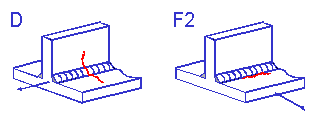
It is then assumed that any complex weld geometry can be described by one of the standard classifications.
Material Properties
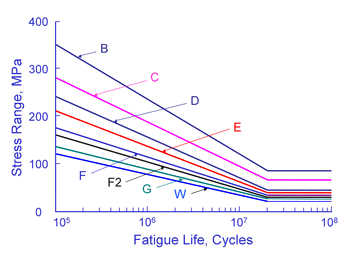
The curves shown above are valid for structural steel welds. Fatigue lives are not dependant on either the material or the applied mean stress. Welds are known to contain small cracks from the welding process. As a result, the majority of the fatigue life is spent in growing these small cracks. Fatigue lives are not dependant on material because all structural steels have about the same crack growth rate. The crack growth rate in aluminum is about ten times faster than steel and aluminum welds have much lower fatigue resistance. Welding produces residual stresses at or near the yield strength of the material. The as welded condition results in the worst possible residual or mean stress and an external mean stress will not increase the weld toe stresses because of plastic deformation. Fatigue lives are computed from a simple power function.

The constant C is the intercept at 1 cycle and is tabulated in the standard. This constant is much larger than the ultimate strength of the material.
The standard is only valid for fatigue lives in excess of 105 cycles and limits the stress to 80% of the yield strength. Experience has shown that the SN curves provide reasonable estimates for higher stress levels and shorter lives. In eFatigue, the maximum stress range permitted is limited by the ultimate strength of the material for all weld classes.
Design Criteria
Test data for welded members has considerable scatter as shown below for butt and fillet welds.
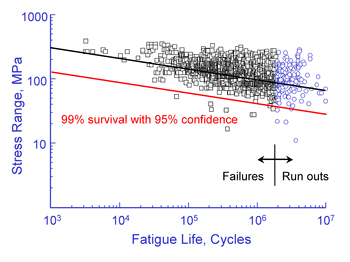
Some of this scatter is reduced with the classification system that accounts for differences between the various joint details. The standard give the standard deviation of the various weld classification SN curves.
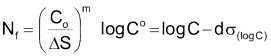
The design criteria d is used to determine the probability of failure and is the number of standard deviations away from the mean. For example d = 2 corresponds to a 2.3% probability of failure and d = 3 corresponds to a probability of failure of 0.14%.
© 2026 — Serene Epic Bay