Actress Kushboo Nude Scene Actress Kushboo Nude Scene
Actress Kushboo Nude Scene Home News Planets Renderings Objects Drawings Tutorials Actress Kushboo Nude Scene
The Sun Mercury Venus Earth Mars Jupiter Saturn Uranus Neptune Pluto

Actress Kushboo Nude Scene Site

: One of her most famous comedy scenes involves her bathing sequence that leads to a hilarious interaction with Rajinikanth.

: She played a wealthy woman who values love over riches, a role that cemented her "girl-next-door" appeal during her peak years.

Her energetic debut in Tamil cinema alongside Kamal Haasan in Vetri Vizha set the stage for her glamorous image.

Kushboo Sundar remains an unparalleled phenomenon in South Indian cinema. Moving from a child artist in Bollywood to the reigning deity of Kollywood, her career spans over four decades and hundreds of films across Tamil, Telugu, Malayalam, and Kannada cinema. Her impact was so profound that fans built a temple for her at Tiruchirappalli in the 1990s—a historic first for any Indian actress. Her success relied on a rare combination of expressive acting, magnetic screen presence, and the ability to command the box office alongside or even independent of male superstars. Actress Kushboo Nude Scene

The emotional climax where Nandhini stands up to her brothers. Kushboo delivers a powerful monologue on love and autonomy. Her performance blends vulnerability with defiance, earning her the Tamil Nadu State Film Award for Best Actress. Rickshaw Mama (1992) – The Courtroom Breakdown

Kushboo began her career as a child artist in Bollywood ( The Burning Train , Laawaris ) before moving to South Indian cinema as a lead actress. Her early career was defined by bubbly, romantic roles.

This public link is valid for 7 days and shares a thread, including any personal information you added. This link or copies made by others cannot be deleted. If you share with third parties, their policies apply. Can’t copy the link right now. Try again later. : One of her most famous comedy scenes

The constant verbal sparring matches with Jayaram. Kushboo's deadpan delivery of comedic insults proved she could carry a comedy film as a lead protagonist. 4. Mature Roles and the Modern Era

: The Central Board of Film Certification (CBFC) in India historically enforces strict rules against explicit nudity in mainstream commercial cinema. Consequently, mainstream Indian films of Kushboo's era utilized artistic choreography, metaphor, and glamorous song sequences rather than explicit exposure.

In a landmark judgment on April 28, 2010, the against Kushboo. The court held that her remarks did not reflect any intent to harm or cause actual harm and saw no legal merit in the accusations. Speaking after the verdict, a relieved Kushboo said she was "relaxed and relieved." Kushboo Sundar remains an unparalleled phenomenon in South

: In 90s commercial cinema, "glamour" roles often involved rain sequences or specific dance costumes. While these were considered bold at the time, they do not constitute nudity. Deepfakes and Morphed Media

(1988), she became a household name with the massive blockbuster Chinna Thambi (1991), which ran for over a year in some theaters. Iconic Movie Scenes

Starting her journey as a child artist in Hindi cinema, Kushboo found her true calling in the South. She quickly became the undisputed queen of Tamil cinema in the 1990s, acting alongside legends like Rajinikanth, Kamal Haasan, Prabhu, and Sathyaraj. 1. Chinna Thambi (1991) Nandhini

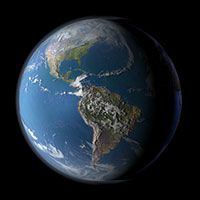
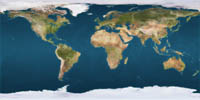
This map is a synthesis between my original earth map, gradient mapping of the USGS DEM information, hand painting, DEM modulation of detail, bathyspheric depth information, and the USGS Ocean clip. Bathyspheric data was used to modulate the color of the water so that deeper areas are a darker blue than shallow areas.
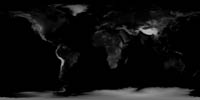
This is pieced together exclusively from the USGS DEM database. It contains landmass elevations only, with the ocean at zero, and the top of Mt. Everest at 255. Use this as a bump map to give the appearance of the Earth's rugged surface features. Some madmen have also used this data in POV Ray as a displacement map on a very finely divided sphere to produce a "true" 3D version of the Earth. The 10K version is VERY large, so make sure you really need that much detail.
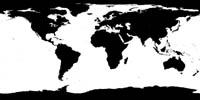
This is derived from USGS DEM data, with the addition of the Arctic ice areas which do not show up on USGS data (since they are not solid land masses.) Use this to control specularity and reflectance of the ocean surface.
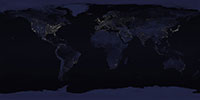
1024 x 512 color image. Very similar to the night lights map as published by NASA on their Blue Marble Page. I took their 30000 x 15000 black and white city lights map, and adapted it with a color table to a colorized version of my earth color map. This comes in 2k, 4k, and 10k versions in color, as opposed to the maximum 2k size of the NASA version of this map (higher resolution versions are available on the paid page only because of their size). Be sure to have a look at the tutorials page for a special rendering tip for using this map.
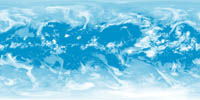
1024 x 512 color image. Based on a mosaic of satellite data, colorized, data errors retouched out, and fixed for seamless wrapping.
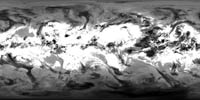
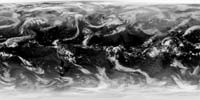
1024 x 512 greyscale image. Based on the same data as the color map, but leveled for the purpose of transparency mapping.

4096 x 2048 greyscale image. Built up out of real satellite imagery based upon a tutorial Dean Scott of Silicon Magic has posted. This is posted in JPEG2000 format. You need a special Photoshop plug-in to make use of jp2 images. I've thoughtfully provided a link:

JPEG 2000 Plugin from Fnord.

Actress Kushboo Nude Scene Site

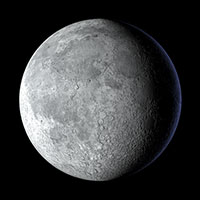
The Moon is a tricky planetoid to render. It has a very distinctive albedo which remains constant across its lit side, regardless of the angle of the surface to the sun. Therefore, standard rendering lighting models do not apply, as they always have a characteristic drop off in intensity as the angle of incidence to the light source increases. In Lightwave, there is an option to use a "non-Lambertian" lighting model on a surface setting. In previous versions of Cinema4D, you had a contrast control in the lighting setup. More recent versions of Cinema4D feature an Oren/Nayar illumination model in the lighting setup which allows you to simulate the lighting properties of "rough" surfaces. This is the method I used on the same pictured here.

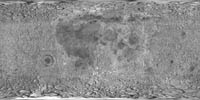
This map is based on a mosaic of satellite data, retouched for visible mosaic seams and for problems with the wrapping seam. Since this image contains highlight and shadow information independent of the location of your light source (inevitable because of how the moon is illuminated by the sun), you'll need to be careful how you light this so you don't break the illusion.

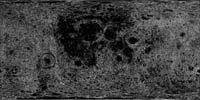
This map is my attempt to derive bump information from the above map. I did a high-pass filter operation to find all the edges of the craters, and then curved the result so that blacks and whites were white, and mid-tones were black. The results came out pretty well, as you can see from the sample image above.


this site works
best on Firefox:


website design © 2006 james hastings-trew